
If you have ever wondered how generative AI actually works, you’re definitely not alone. You’ve probably seen AI tools writing content, creating images, even generating videos, it is everywhere in 2026.
But here’s the good part, you don’t need a technical background to understand it. Once you break it down step by step, it actually starts to feel pretty simple.
In this article, I am going to walk you through how generative AI models work in a clear, practical way, so you can not just understand it, but actually start using this knowledge in real situations.
What Is a Generative AI Model?
A generative AI model is a system that creates new content instead of just analyzing existing data. That content can be text, images, audio, or even code.
Think of it like this: instead of just recognizing patterns, the model learns those patterns and then uses them to produce something new. It doesn’t copy content. It generates it based on what it has learned.
So when you ask me how a generative AI model actually works, I would put it simply for you like this, it studies a huge amount of data, learns the patterns inside it, and then uses those patterns to create something new in its own way.
How Does a Generative AI Model Work?
Let’s break it down into simple steps so you can clearly understand the process.
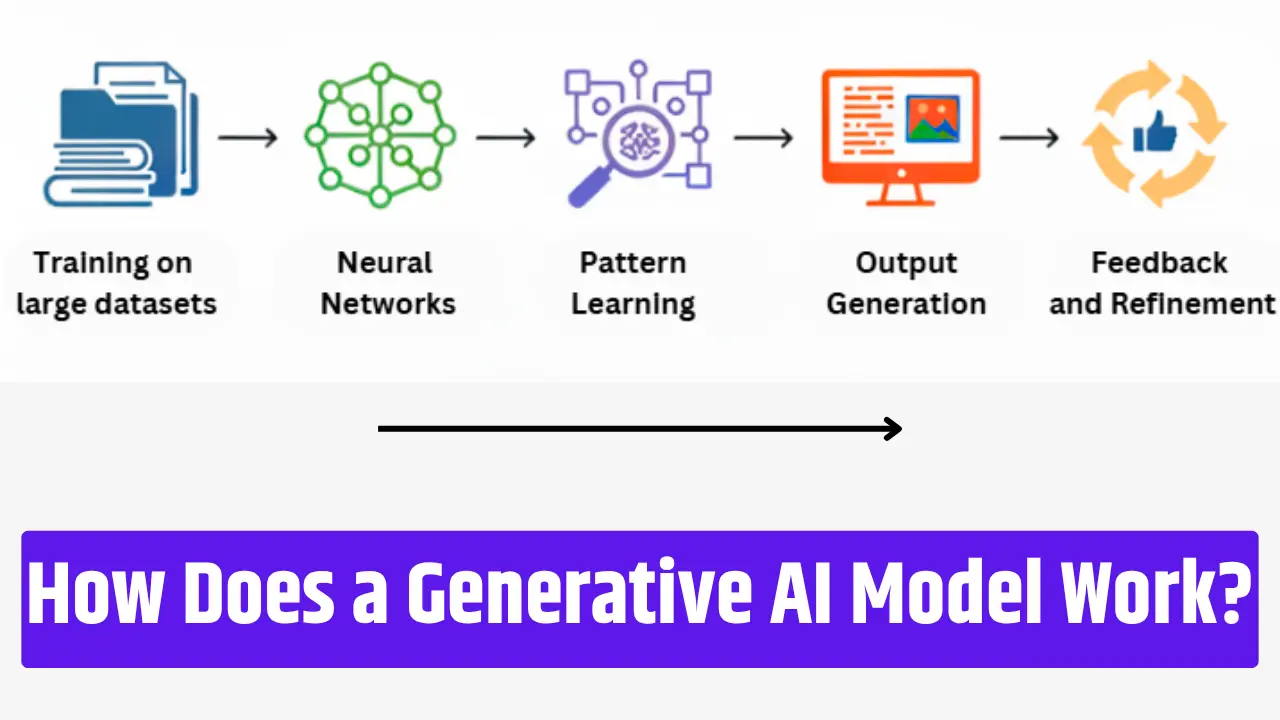
Learning from Data
Everything starts with data. A generative AI model is trained on large datasets such as books, websites, images, or videos.
For example, a text model learns from millions of sentences. It starts recognizing patterns like sentence structure, grammar, and tone.
Over time, it becomes good at predicting what comes next in a sentence. This is the foundation of how it generates content.
Understanding Patterns
The model doesn’t memorize exact content. Instead, it learns relationships between words, pixels, or sounds.
For example, it learns that:
- “Hello” is often followed by “how are you”
- A sky is usually blue in images
- Certain coding patterns repeat in programming
This pattern recognition is what allows the model to create realistic outputs.
Training with Neural Networks
Most generative AI models use neural networks. These are systems designed to process data in layers and improve over time.
During training, the model makes predictions and checks how accurate they are. If it makes a mistake, it adjusts itself.
This process repeats millions of times until the model becomes highly accurate at generating content.
Generating New Content
Once trained, the model can start generating new outputs. When you give it a prompt, it predicts what should come next based on what it has learned. It does this step by step, building content piece by piece.
That’s why answers feel natural and human-like. At this stage, you can clearly see how does a generative AI model work in real use. It’s essentially predicting and creating at the same time.
Types of Generative AI Models
Not all generative models work the same way. Different types are used for different tasks.
Text-Based Models
These models generate written content like articles, emails, or chat responses. They focus on predicting the next word in a sequence.
They are widely used in blogging, customer support, and content creation.
Image Generation Models
These models create images from text prompts. They start with random noise and gradually turn it into a clear image.
This is why you can type a description and get a realistic picture in seconds.
Code Generation Models
These are trained on programming data. They help developers write code faster by suggesting functions, fixing errors, or generating entire scripts.
Real-Life Example You Can Relate To
Let me make this feel real for you.
- Let’s say you want to write a blog introduction. You come to me and say, “Write an introduction about digital marketing.”
- What I do for you behind the scenes is analyze your input and start generating text based on patterns I have learned from similar content.
- I amm not copying any specific article for you. Instead, I’m creating a completely new introduction that follows the kind of writing style people usually use.
That’s a simple, practical way for you to understand how a generative AI model works in your everyday tasks.
What Makes Generative AI So Powerful?
The biggest strength of generative AI is its ability to save time while maintaining quality.
Instead of starting from scratch, I generate drafts, ideas, or designs instantly. This helps me to focus more on editing and strategy.
It’s especially useful for:
- Content creation
- Marketing campaigns
- Product design
- Software development
That’s why businesses are rapidly adopting AI tools in their workflows.
Limitations You Should Know
Even though generative AI is powerful, it’s not perfect.Sometimes it can produce incorrect or misleading information. It can also sound confident even when it’s wrong.
That’s why I always review and edit the output before using it. Understanding these limitations helps you use AI more effectively.
How You Can Start Using Generative AI
You don’t need any advanced skills to get started with this, I will make it simple for you.
I would suggest you begin with small, practical tasks like asking me to write emails, generate blog ideas, or create social media captions for you. That’s usually the easiest way to get comfortable.
As you start using it more, you can slowly move into more advanced things like automation or building your content strategy.
From my experience, the key for you is just to experiment a bit and see what actually works best for your needs.
Final Thoughts
Now you have got a clear understanding of how generative AI actually works without getting lost in all the technical stuff. When I break it down for you, it really comes down to this: it learns from data, picks up patterns, and then uses those patterns to create something new. That’s what makes it so powerful in today’s digital world.
From what I have seen, if you use it the right way, it can genuinely save you a lot of time, boost your productivity, and help you create better content much faster. But honestly, the real advantage is not just the technology itself, it is how you choose to use it to solve problems and create value in your own work.
If you have got any questions, just drop them in the comments, I will do my best to answer you!
READ ALSO:

I am Kunal Kumar, a software engineer and the founder of AI Squaree. With over 5 years of blogging experience and hands-on testing of AI tools, I share practical, experience-based insights to help readers make smarter decisions in the fast-evolving AI space.