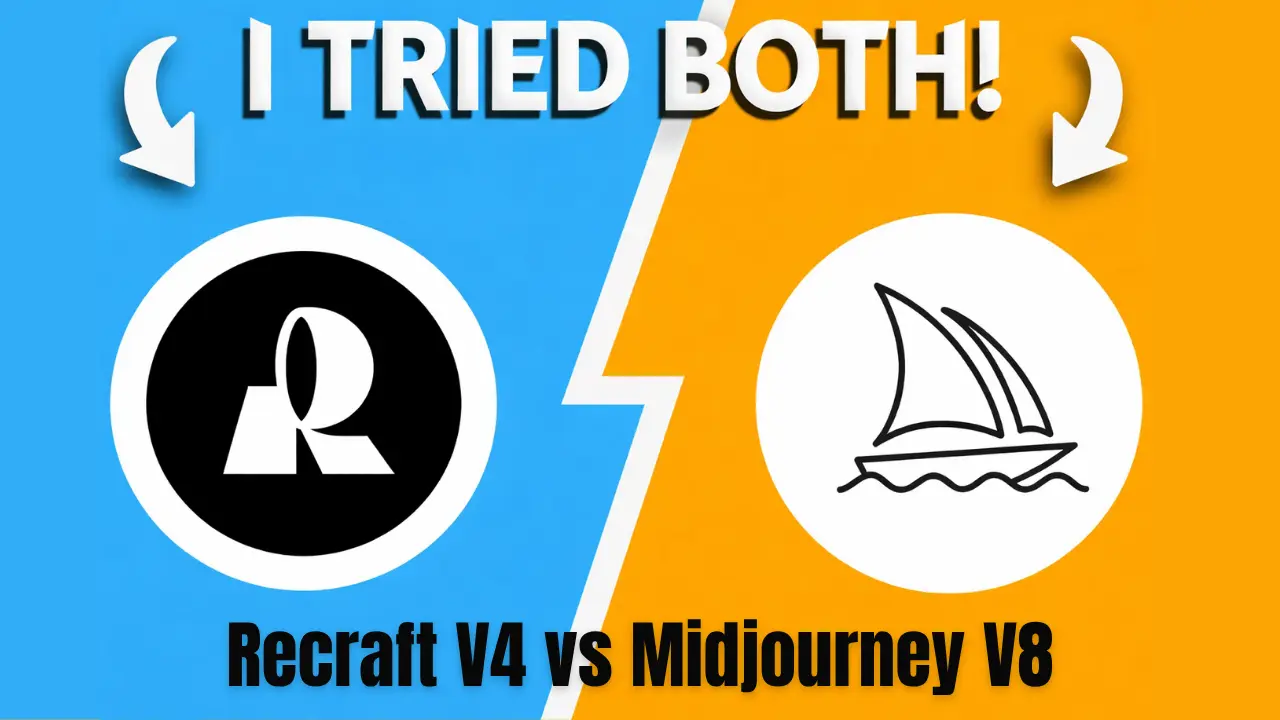
If you create visuals for work, whether it is brand graphics, social posts, concept art, or client mockups, you have probably asked yourself the same question I did a couple months back: Recraft V4 or Midjourney V8? Both dropped major updates in early 2026, and both promise better images than anything we saw in 2025. But they feel built for different jobs.
I have been running both tools side by side since Recraft V4 launched in February and Midjourney V8 hit alpha in mid-March. I have generated hundreds of images for real client projects, from logo systems to editorial-style photos. No hype, just what actually happened in my workflow. By the end of this piece, you will know exactly which one (or both) makes sense for what you do.
What Recraft V4 Actually Does Differently
Recraft built V4 from the ground up with designers in mind. The big breakthrough is not just prettier, it is “visual taste.” The model understands balanced composition, harmonious color palettes, and intentional layouts the way a senior designer would.
You get four model flavors:
- Standard raster (1024×1024, about 10 seconds)
- Vector (native SVG, 15 seconds)
- Pro raster (2048×2048, 30 seconds)
- Pro Vector (45 seconds)
The SVG output is a game-changer. I prompted “minimalist coffee shop logo, clean lines, negative space, navy and cream palette” and got a perfectly editable vector file I dropped straight into my client deck. No tracing, no cleanup. That alone has cut my logo revision rounds in half.
Text rendering is another standout. I can put readable headlines, taglines, or even multi-line body copy directly in the image and it rarely warps. For social media carousels or product banners, this means I am not fighting the AI anymore.
What Midjourney V8 Brings to the Table
Midjourney V8 (currently in alpha on their new web interface) feels like the artistic evolution of everything that made the tool addictive. Generation is roughly 5× faster than V7. Native 2K HD mode gives you crisp detail without extra upscaling steps. Prompt adherence is tighter, especially for complex scenes with multiple subjects and specific lighting directions.
Where it shines brightest is creative direction and photorealism. I prompted “young woman walking through Tokyo street market at golden hour, cinematic film still, subtle film grain, shallow depth of field” and got something that looked like it came off a high-end camera. The emotional tone and storytelling are still unmatched.
Style references, moodboards, and personalization carry over from V7 and work even better here. If you already have a library of looks you love, V8 respects them more faithfully.
Head-to-Head: Speed, Quality, Price, and Features
Image quality
Recraft V4 wins for design polish and consistency. Colors feel intentional, layouts feel balanced, and assets look production-ready. Midjourney V8 wins for artistic impact and photoreal detail. If your client wants something that stops the scroll or feels cinematic, MJ still edges it out in my tests.
Text and vectors
Recraft destroys this category. Midjourney’s text has improved in V8 but still isn’t reliable enough for client-facing typography. And vectors? MJ doesn’t offer native SVG at all.
Speed
Midjourney V8 is noticeably quicker in everyday use, often 4-5 seconds for standard jobs. Recraft’s standard model sits around 10 seconds, Pro around 30. For rapid ideation, MJ feels snappier right now.
Pricing
Recraft starts with a generous free tier (though images are public) and paid plans from about $12/month with credit-based billing. It’s predictable for design-heavy work. Midjourney runs on subscriptions from $10/month (Basic) up to $120 (Mega), with GPU time limits on faster generations.
If you generate in bursts, Recraft’s credit system often feels cheaper for professional output.
Platform and workflow
Recraft lives in a clean web app built for designers, easy uploads, style libraries, batch variations, and direct exports. Midjourney’s alpha web interface is improving fast, but many people still love the Discord chaos for community inspiration.
Real-World Use Cases That Actually Matter
Here’s how I split my own work:
Brand assets and marketing collateral: Recraft V4 every single time. I recently built an entire 12-piece social campaign for a fintech client like icons, banners, quote graphics, all with perfect text and consistent branding. Exported SVGs went straight to the developer.
Concept art and mood exploration: Midjourney V8. For a book cover project, I used V8 to generate 40 wildly different directions in one evening. The emotional range and stylistic variety helped the author pick the perfect vibe before we refined in Recraft.
Product mockups with text: Recraft. I needed packaging visuals with accurate product names and claims. One prompt, clean readable text, vector files ready for print.
Personal artistic projects or client “wow” pieces: Midjourney. The cinematic quality still makes people lean in.
In my experience, the smartest creators aren’t picking one, they are using both inside the same project. Generate the visionary direction in Midjourney, then refine consistency and production assets in Recraft.
Common Myths and Mistakes I See People Make
Myth 1: “The best model is the one with the highest benchmark score.”
Benchmarks are useful, but real work cares about editable files and workflow fit. I’ve seen designers waste weeks trying to force Midjourney text into client deliverables.
Myth 2: “I should stick with whatever I already know.”
V4 and V8 are different enough that switching tools for the right job saves time and money.
Biggest mistake: Using the same prompt style on both. Recraft rewards clear design language (“balanced composition, harmonious palette, negative space”). Midjourney loves cinematic, artistic descriptors. Spend 10 minutes learning each model’s sweet spot and you’ll double your success rate.
Practical Tips to Get Better Results Today
- For Recraft, describe layout and mood first: “clean minimalist poster, rule of thirds, plenty of white space, modern sans-serif headline…”
- For Midjourney V8, lean into storytelling, “cinematic, moody lighting, film still, subtle grain…”
- Always test the same prompt in both tools before committing to a direction.
- Use Recraft’s Exploration mode when you want fresh variations without changing your prompt much.
- Enable Midjourney’s –hd mode only when you need print-ready resolution, otherwise the speed advantage disappears.
Why You Should Trust This Recraft V4 vs Midjourney V8 Review
I am not a brand ambassador for either company. I am a working designer who bills clients every month using AI tools. Last year I burned through thousands of credits testing everything from Flux to Ideogram. When Recraft dropped V4, I switched half my projects over immediately because the vector output and text quality saved me hours in Illustrator. Then Midjourney V8 alpha landed and I jumped back in for artistic work.
This comparison comes from real projects, not cherry-picked screenshots. I have paid for both subscriptions out of my own pocket, tracked generation times, and exported files into Figma and Photoshop. That’s the only way to know what actually works when deadlines hit.
FAQs – Recraft V4 vs Midjourney V8 Review
Q1. Which is better for logos?
Recraft V4. Native SVG and design taste make it the clear winner.
Q2. Is Midjourney V8 worth it if I already love V7?
Yes for speed and detail, but the artistic leap isn’t night-and-day yet. Alpha means it’s still evolving.
Q3. Can I use these commercially?
Both allow it on paid plans. Recraft’s free tier images are public and have restrictions, upgrade for client work.
Q4. Do I need to learn new prompting?
Only a little. The core skills transfer, but each tool has its own dialect that rewards practice.
The Bottom Line
Recraft V4 is the practical, production-focused winner for most designers and marketers who need clean, editable, text-perfect assets that look intentional. Midjourney V8 remains the creative powerhouse when you want images that feel alive, cinematic, or emotionally resonant.
In my workflow, I start most projects in Midjourney V8 to explore the vision, then finish in Recraft V4 for polish and delivery. That combination has cut my delivery time by about 40% while making clients happier.
You don’t need to pick a side forever. Try both (Recraft’s free tier and Midjourney’s Basic plan are low-commitment entry points). Spend one focused afternoon prompting the same brief in each. You’ll feel the difference immediately and know exactly which tool belongs in your toolbox.
The AI image game moves fast, but right now these two tools complement each other better than they compete. Use the right one for the job and you’ll spend less time fighting the technology and more time doing the creative work you actually love.
READ ALSO:
I am Kunal Kumar, a software engineer and the founder of AI Squaree. With over 5 years of blogging experience and hands-on testing of AI tools, I share practical, experience-based insights to help readers make smarter decisions in the fast-evolving AI space.