
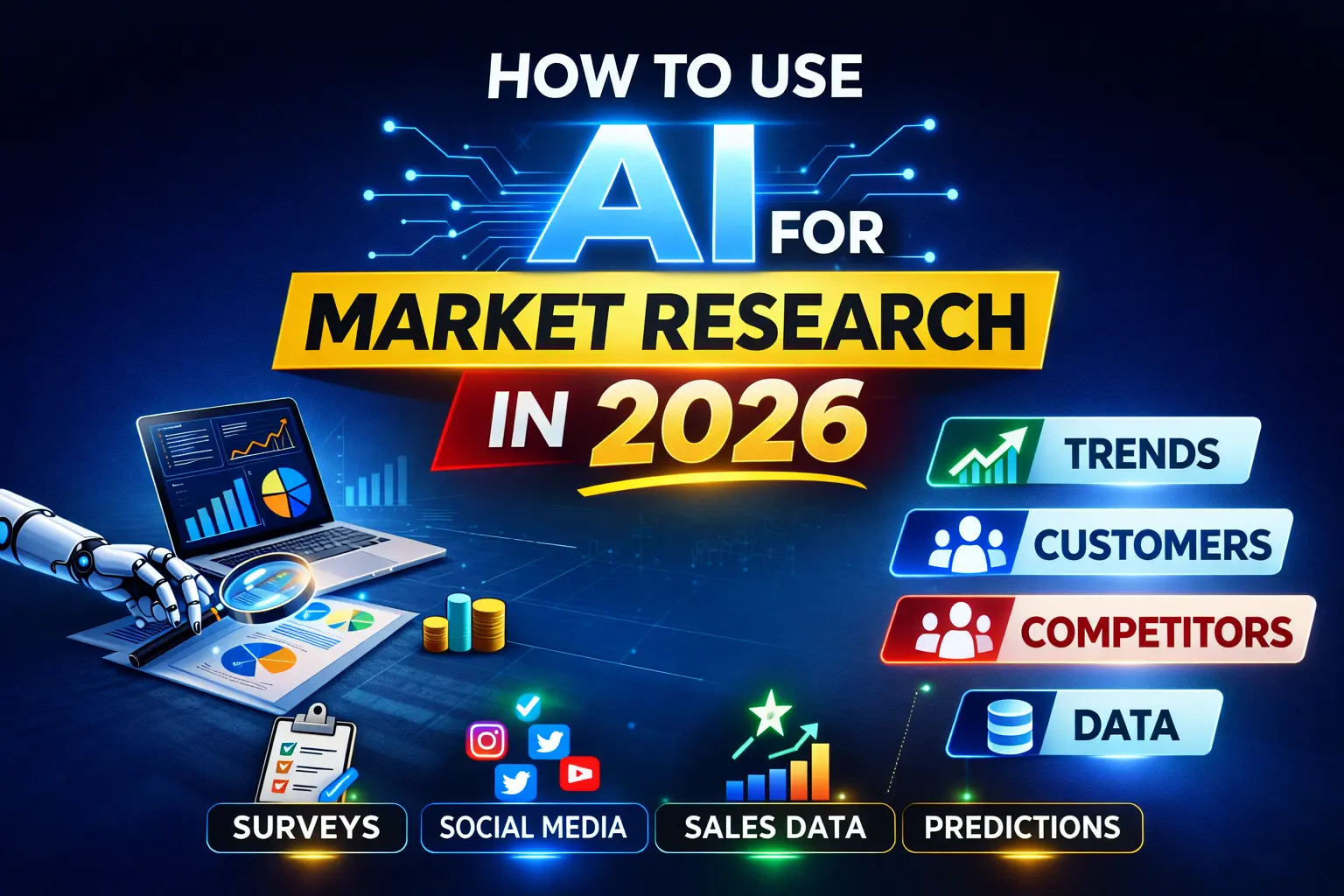
Market research used to mean long surveys, expensive focus groups, and weeks of data analysis. In 2026, it looks very different.
If you know how to use AI for market research, you can analyze customer behavior, identify trends, and validate business ideas in a fraction of the time. Whether you’re running a startup, building a personal brand, or managing a marketing team, AI-powered market research tools can give you a serious competitive edge.
The key isn’t just using AI. It’s using it strategically. Let’s walk through exactly how you can do that.
Why AI Market Research Matters in 2026
Consumer behavior changes fast. Trends rise and fall in weeks, not years. If you rely only on traditional research methods, you’ll always be one step behind. AI for market research helps you:
- Analyze large amounts of data instantly
- Detect patterns you might miss manually
- Monitor competitors in real time
- Understand customer sentiment at scale
Instead of guessing what your audience wants, you can make decisions backed by real data. And in 2026, that speed makes all the difference.
Step 1: Use AI to Identify Market Trends
The first step in any market research process is understanding what’s happening in your industry. AI tools can scan search engines, social media platforms, forums, and news sites to detect emerging topics. This is especially useful if you’re launching a product or creating content.
For example, imagine you’re starting a fitness coaching business. AI-powered trend analysis tools can show you that interest in “AI workout plans” or “home gym optimization” is growing. That insight helps you position your offer early, before the market becomes crowded. When using AI for market research in 2026, trend discovery should always come first.
Step 2: Analyze Customer Sentiment
Understanding what people are saying about your niche is just as important as spotting trends. AI sentiment analysis tools can scan thousands of reviews, comments, and social media posts to determine whether customers feel positive, negative, or neutral about certain products or brands.
Let’s say you’re researching the skincare market. Instead of reading 500 product reviews manually, AI can summarize common complaints like “too oily” or “caused irritation.” That gives you direct insight into gaps in the market.
Customer sentiment analysis is one of the most powerful applications of AI in market research because it reveals emotional triggers, not just numbers.
Step 3: Use AI for Competitor Research
In 2026, competitor analysis has become smarter and more automated. AI market research tools can:
- Analyze competitors’ website content
- Track keyword rankings
- Identify high-performing blog posts
- Evaluate ad copy and messaging
For example, if you run an e-commerce store, you can use AI to study your competitor’s product descriptions, pricing patterns, and SEO strategy.
You might discover that their top traffic comes from educational blog content rather than product pages. That insight can shift your own marketing strategy. Using AI for competitor research allows you to make informed moves instead of reactive ones.
Step 4: Automate Survey Analysis
Surveys are still useful in 2026. The difference is how you analyze them. Instead of manually sorting through responses, AI can:
- Categorize open-ended answers
- Identify recurring themes
- Highlight unusual or unexpected insights
- Generate summary reports
Imagine you send a survey to 1,000 customers asking why they chose your product. AI can instantly group answers into themes like “price,” “quality,” or “customer service.” That saves hours of work and gives you clear direction on what to emphasize in your marketing. When learning how to use AI for market research, automation is one of your biggest advantages.
Step 5: Predict Customer Behavior
One of the most advanced uses of AI in market research is predictive analytics. AI can analyze historical data, purchasing behavior, and engagement metrics to forecast future trends.
For example, if you run a subscription service, AI might predict which customers are likely to cancel based on usage patterns. That allows you to intervene early with special offers or improved onboarding.
Predictive market research helps you move from reactive to proactive decision-making. In 2026, businesses that predict behavior outperform those that simply analyze past data.
Step 6: Validate Business Ideas Faster
If you’re launching a new product or service, AI can help you validate your idea before investing too much time or money. You can use AI tools to:
- Analyze search demand
- Evaluate keyword competition
- Identify target audience demographics
- Estimate content performance potential
For instance, before launching a course on remote team productivity, you could use AI to examine search trends, common questions, and competitor offerings.
If demand is high and competition is manageable, that’s a strong signal to move forward. AI-driven market research reduces the risk of building something nobody wants.
Common Mistakes to Avoid
Even though AI tools are powerful, they aren’t flawless. One common mistake is relying only on automated insights without applying human judgment. AI can identify patterns, but you still need to interpret them correctly.
Another mistake is using too many tools without a clear objective. Start with a specific research goal. Are you trying to understand your audience? Improve product positioning? Enter a new market? Clarity makes AI more effective.
Finally, avoid assuming data equals truth. AI-generated insights are based on available information. Always cross-check important decisions.
How to Build an AI-Powered Market Research Workflow
To use AI for market research effectively in 2026, create a simple workflow. Start by defining your research question. Then gather data using AI-powered trend tools, competitor analysis platforms, and sentiment scanners.
Next, analyze patterns and summarize findings. Finally, apply those insights to your marketing strategy, product development, or content planning.
For example, a startup launching a budgeting app could:
- Research trending financial concerns
- Analyze competitor messaging
- Study app reviews for pain points
- Use predictive insights to refine pricing
This structured approach ensures AI supports strategy rather than replacing it.
Final Thoughts
Learning how to use AI for market research in 2026 is no longer optional. It’s a competitive advantage. AI helps you move faster, analyze deeper, and make smarter decisions. From identifying trends to predicting customer behavior, the possibilities are powerful.
But remember, AI is a tool. Your strategy, creativity, and judgment still matter. If you combine AI-driven insights with clear goals and thoughtful interpretation, you can uncover opportunities others miss. And in today’s fast-moving digital landscape, that difference can define your success.
Now the next step is yours. Start small, experiment with AI market research tools, and turn data into action.

Kunal Kumar is an engineer and the founder of AISquaree, where he simplifies artificial intelligence for everyday users. With over two years of blogging experience and hands-on testing of AI tools, he shares well-researched, practical insights to help readers make informed decisions in the fast-evolving AI space.