In 2026, artificial intelligence is everywhere. From content creation to customer support and data analysis, businesses rely on AI to move faster and stay competitive. But as AI adoption grows, a new question keeps coming up: what’s the difference between AI agents and AI tools?
If you have been using AI software in your business, you may already be working with both without realizing it. Understanding the difference between AI agents vs AI tools is more than a technical detail. It directly affects how you automate tasks, allocate resources, and scale operations.
Let’s break it down in simple terms so you can decide what your business actually needs.
What Are AI Tools?
AI tools are software applications designed to perform specific tasks. They respond to your input and generate an output. Think of them as assistants that wait for instructions.
For example, if you use an AI writing platform to generate blog ideas, summarize a document, or rewrite a paragraph, that’s an AI tool. It performs a defined action when prompted.
Most AI tools focus on one clear function. Some help with graphic design. Others analyze spreadsheets. Others automate email marketing. You tell the tool what to do, and it does it. In short, AI tools are reactive. They require human direction to operate.
What Are AI Agents?
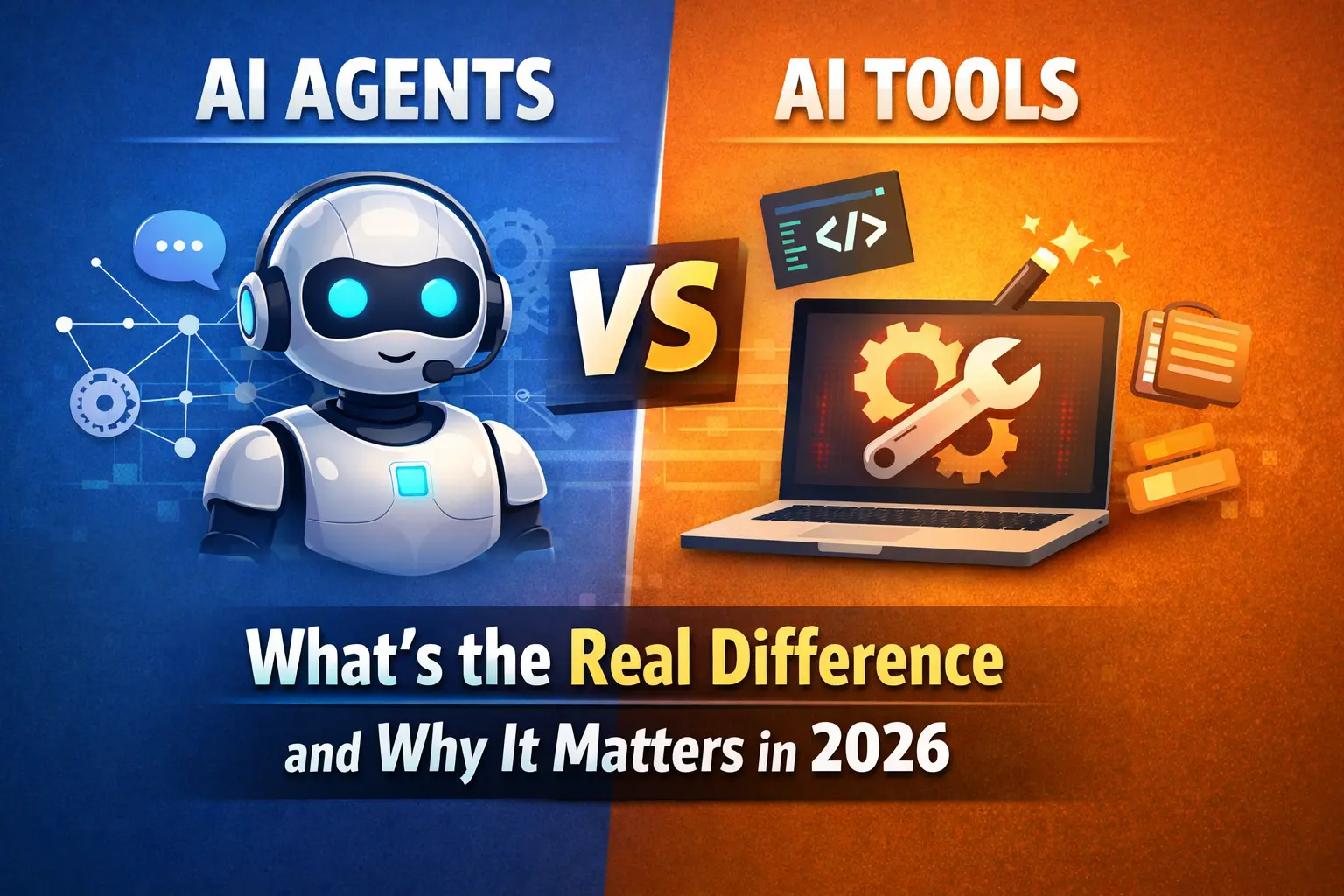
AI agents go a step further. Instead of simply responding to prompts, they can act independently to achieve a goal. An AI agent is designed to make decisions, plan actions, and execute tasks across multiple systems with minimal supervision. Rather than waiting for constant input, it can analyze a situation and determine what steps to take next.
For example, imagine you ask an AI agent to “increase online sales this month.” Instead of just generating suggestions, the agent could analyze website traffic, adjust ad campaigns, test pricing strategies, and monitor results automatically.
AI agents are proactive. They don’t just assist you. They act on your behalf within defined boundaries.
AI Agents vs AI Tools: The Core Differences
Understanding the difference between AI agents and AI tools comes down to autonomy, scope, and decision-making ability.
AI tools perform specific tasks when prompted. They’re excellent for focused jobs like generating text, editing photos, or analyzing a dataset.
AI agents, on the other hand, manage workflows. They can handle multi-step processes, make conditional decisions, and adapt based on outcomes.
Think of it this way. An AI tool is like a calculator. You input numbers and get a result. An AI agent is more like a financial advisor who monitors your portfolio, makes adjustments, and reports back on performance. Both are useful, but they serve very different purposes.
Real-World Examples in 2026
To make this clearer, let’s look at practical examples of AI agents vs AI tools in business operations.
Example 1: Marketing Automation
An AI tool might generate email subject lines or analyze campaign performance. It waits for your instructions and produces results accordingly.
An AI agent, however, could monitor customer behavior, segment audiences automatically, launch campaigns, adjust budgets, and optimize performance without needing daily input. The tool helps you work faster. The agent helps your system run itself.
Example 2: Customer Support
A basic AI chatbot that answers FAQs based on predefined responses is an AI tool. It handles specific questions and escalates complex issues to human agents.
An advanced AI agent could analyze customer sentiment, detect recurring product issues, update knowledge base articles, and notify relevant departments automatically. It doesn’t just answer questions. It improves the support ecosystem.
Example 3: Operations Management
An AI analytics tool might generate weekly performance reports when you request them. An AI agent could continuously monitor key metrics, flag anomalies, suggest corrective actions, and even implement changes within connected systems.
In 2026, more businesses are shifting toward AI agents because automation is moving from task-level to goal-level execution.
Why This Difference Matters for Your Business
The difference between AI agents and AI tools matters because it impacts your automation strategy.
If your goal is to improve individual tasks, AI tools may be enough. They’re usually easier to implement, cost less, and require less integration.
But if you want end-to-end automation, where processes run with minimal oversight, AI agents become far more valuable.
For growing businesses, this distinction is critical. Using only AI tools can lead to fragmented workflows. You may save time in isolated areas, but you still manage the overall system manually.
AI agents, when implemented correctly, connect systems and reduce operational complexity.
However, autonomy also requires responsibility. AI agents need clear boundaries, strong data governance, and human oversight to avoid unintended decisions.
When Should You Use AI Tools?
AI tools are ideal when:
- You need help with a specific repetitive task.
- You want to enhance productivity without overhauling systems.
- You’re testing AI adoption in your organization.
For example, a content team might start with AI writing tools to draft outlines before investing in broader AI-driven workflow automation.
When Should You Use AI Agents?
AI agents make sense when:
- You’re managing complex workflows across multiple platforms.
- You want to reduce ongoing manual supervision.
- You’re focused on scaling operations efficiently.
For instance, an e-commerce company handling thousands of transactions daily might use AI agents to manage inventory, adjust pricing dynamically, and optimize ad campaigns in real time.
In 2026, the competitive advantage often lies in how well your systems communicate and adapt. AI agents support that adaptability.
The Future of AI in 2026 and Beyond
AI technology is evolving rapidly. While AI tools remain valuable, the shift toward intelligent, autonomous AI agents is accelerating.
Businesses are no longer asking, “How can AI help with this task?” Instead, they’re asking, “How can AI manage this objective?” That mindset shift is significant. It changes how you design workflows, train teams, and evaluate performance.
Still, the smartest strategy isn’t choosing one over the other. It’s combining both. Use AI tools for precision and creativity. Use AI agents for coordination and automation.
Final Thoughts
Understanding AI agents vs AI tools is essential in 2026 because it shapes how you approach digital transformation. AI tools respond to instructions and complete defined tasks. AI agents act more independently, managing processes and pursuing goals within set parameters.
If you’re looking to streamline operations, reduce manual workload, and scale sustainably, knowing which approach fits your business can save time and money.
The real question isn’t whether you should use AI. It’s whether you’re using the right type of AI for the job.
TRY TOOLS :-

I am Kunal Kumar, an engineer and the founder of AI Squaree. With over 5 years of blogging experience and hands-on testing of AI tools, I share practical, well-researched insights to help readers make smarter decisions in the fast-evolving AI space.